Electronic instrumentation
How do you follow the growth of a cell culture without taking it out of the incubator? We design circuits that turn changes at a sensing electrode into a signal that can be recorded over time.
Electronics for cell stimulation
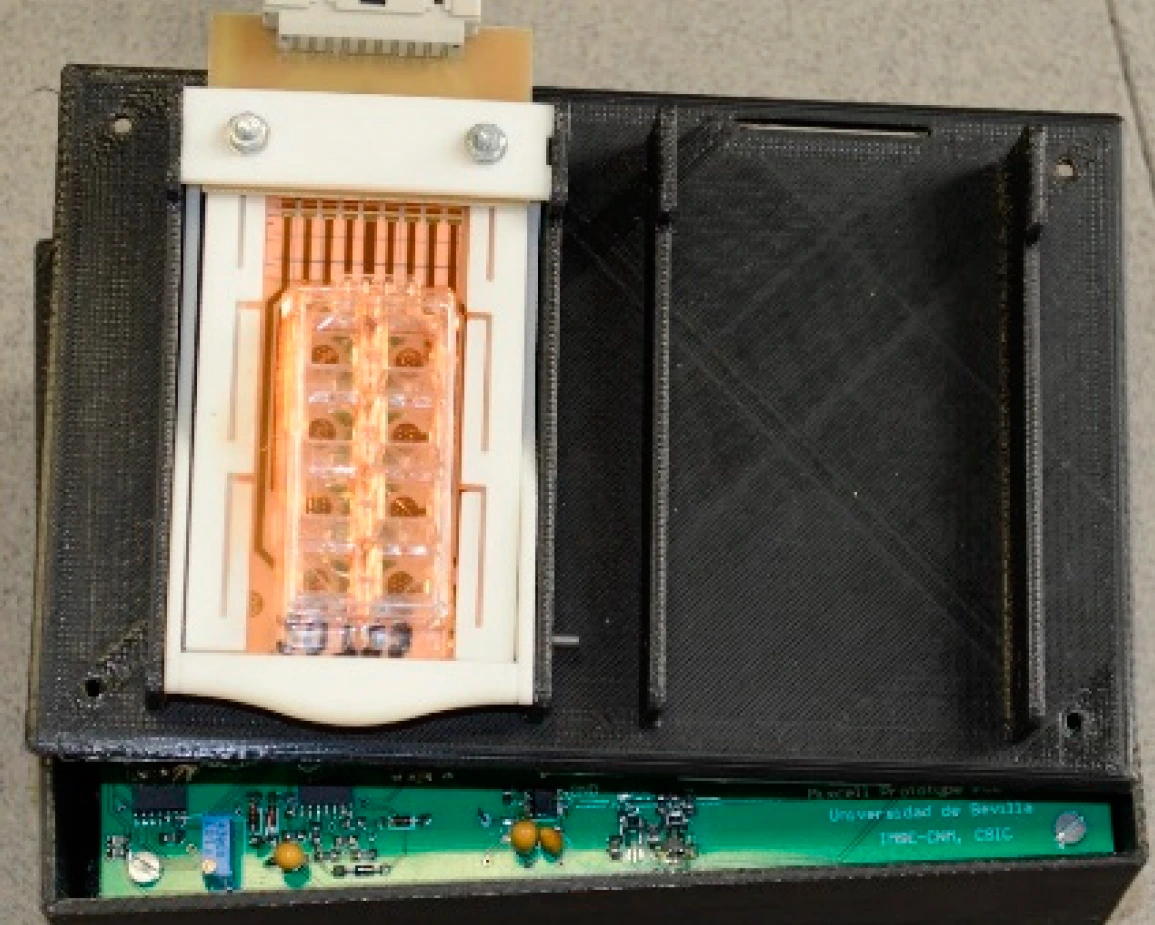
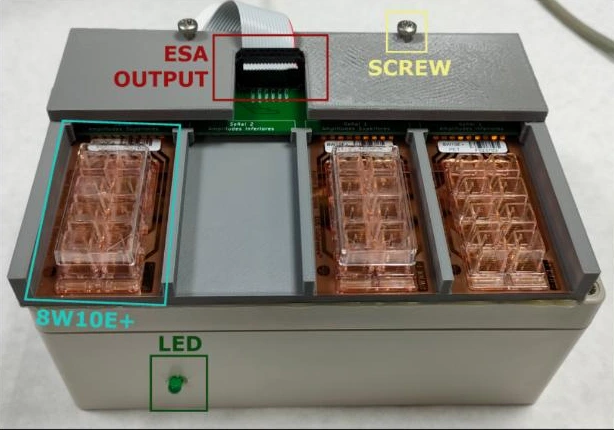
Daniel Martín Fernández built a system with separate boards for signal conditioning and for connecting culture plates. A 3D-printed holder keeps the plates and interface board in place. His doctoral thesis documents the assembled instrument, the circuit boards and the electrical characterisation of the electrodes.
A programmable AC current source
For impedance spectroscopy, the instrument needs a known excitation signal. A prototype built around an STM32G4 generated a waveform from a table of samples using its on-chip converter and amplifiers. Bench tests measured noise and harmonic distortion and compared readings on 47 and 100 kΩ resistors. Both estimates fell outside the nominal 5% tolerance, identifying a limit of this implementation. The firmware is available alongside the study.
Tuning the readout to the assay
Electrode geometry, the cell layer and the culture medium all influence the signal. With an electrical model of this interface, we can examine how a filter setting changes sensitivity before building the circuit. A computer-aided design tool supports this process. A spectroscopy study then simulated different degrees of electrode coverage while varying the centre frequency and quality factor of the filter.
The culture well as part of the circuit
As adherent cells cover a gold electrode, they change its electrical impedance. We placed this interface inside the feedback loop of an oscillator. Changes in oscillation frequency and amplitude then provided two signals to compare with independent cell counts. A later wireless prototype recorded N2a cultures inside an incubator and sent readings over Bluetooth to a gateway.