Impedance sensing in implants
Two collaborations use electrical measurements to study different interfaces: blood flowing through a stent and cells growing on porous titanium.
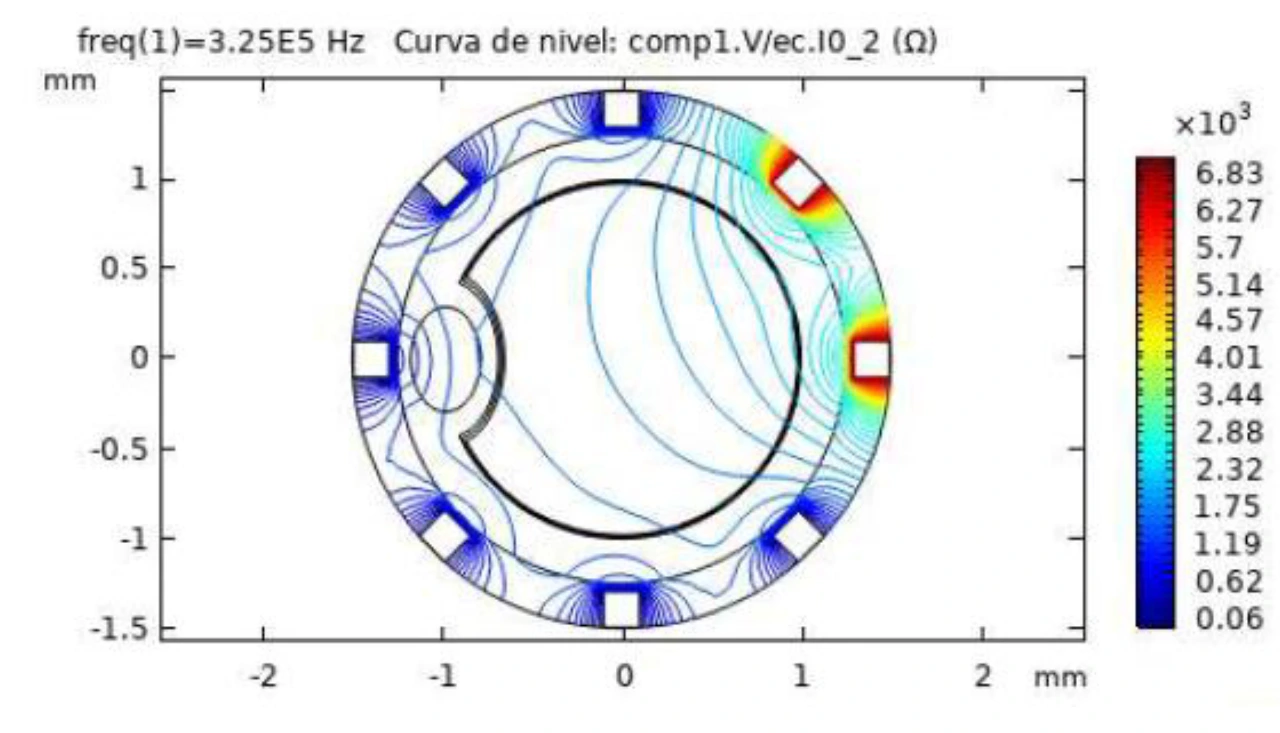
Where is the narrowing in a stent?
Antonio Rodríguez, Pablo Barroso, Alberto Olmo and Alberto Yúfera modelled a ring of eight electrodes in an artery. In finite-element simulations they changed the plaque geometry and calculated the resulting current distribution. In one configuration, current near the plaque fell by more than half relative to the reference artery. The study used these local changes to examine the feasibility of detecting narrowing and locating it around the vessel wall.
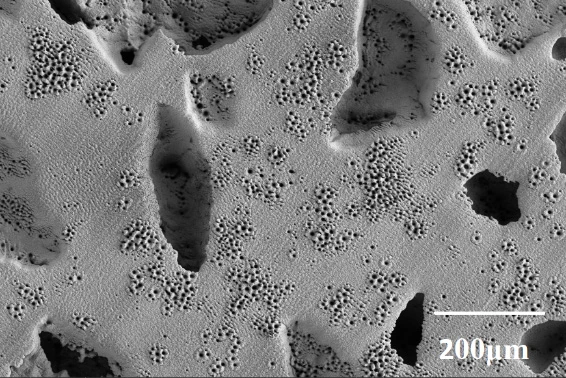
Measuring the surface of porous titanium
In a collaboration with materials and cell scientists, Paula Navarro and colleagues compared titanium discs with different porosities and surfaces textured with a femtosecond laser. They used impedance spectroscopy at 150–500 MHz alongside electron microscopy and cell culture. The surface treatment and the growth of bone-forming cells altered the measured impedance, suggesting a way to characterise specimens electrically.