Wearable bioimpedance spectroscopy
Fluid accumulation in the lower leg changes how it conducts electricity. With the clinical team at Hospital Universitario Virgen del Rocío, we investigate whether repeated ankle measurements can help track oedema in heart failure.
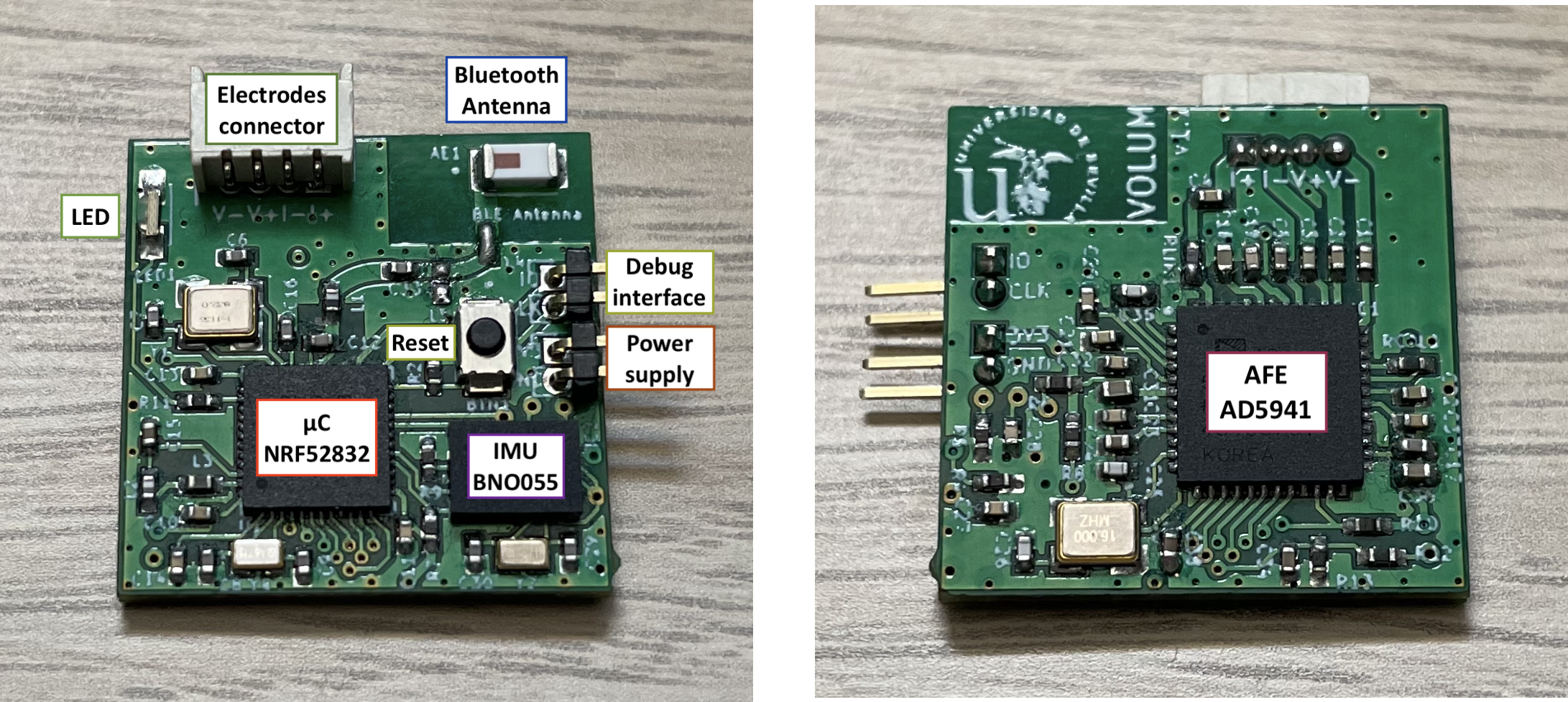
Inside the VOLUM prototype
Two electrodes apply an alternating current and a second pair senses voltage. The prototype measures impedance across frequencies from 1 to 200 kHz, records orientation and transfers readings by Bluetooth. Measurements on reference circuits and comparison with a commercial spectrometer helped characterise the electronics. Body position and unequal contact at the electrodes also affect the signal, particularly at low frequencies.
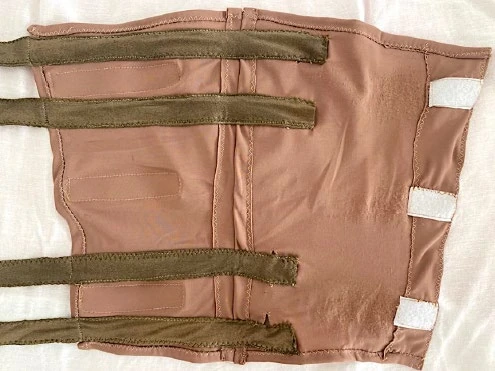
From rigid contacts to a textile ankle band
Patient feedback on the rigid enclosure prompted María Jesús Sánchez and colleagues to sew four conductive strips into an adjustable garment. They tested the textile electrodes with a clinical SFB7 spectrometer in five healthy volunteers and two patients with heart failure. The two patients with oedema had lower measured impedance. This pilot explored the electrode design and repeatability in a small sample.
Relating impedance to leg volume
The electrical reading depends on both tissue composition and leg geometry. A separate modelling study examined how changes in the cross-section of the leg affect the estimated volume. The CaixaResearch Validate project, led by Alberto Olmo at the University of Seville, supported development of the wearable system.